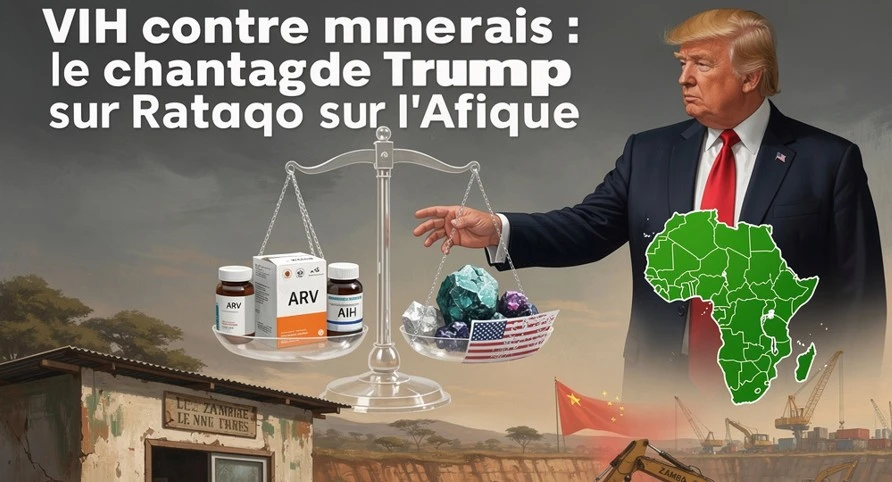
A document revealed by the NGO Health GAP accuses the American administration of blatant blackmail against Zambia. Washington is allegedly threatening to cut off vital financial aid for HIV treatment if the country does not give in to American demands for access to mining resources. This case highlights the growing tensions surrounding the control of strategic raw materials in Africa.
According to the memorandum, the U.S. State Department is considering suspending its health assistance to Zambia if it does not sign a bilateral agreement favorable to American companies in the mining sector. In 2024, this aid amounted to more than $400 million, a significant portion of which was allocated to antiretroviral treatments provided under Pepfar, the U.S. President's Emergency Plan for AIDS Relief. For 2026, a reduction to $320 million is planned, with a drastic drop to $112 million in 2030. The threat is clear: no agreement, no aid.
This alleged blackmail comes amid increased competition for African mineral resources, including copper, cobalt and nickel, which are essential for the energy transition and new technologies. Zambia, Africa's second largest copper producer, is particularly coveted, especially by China, which already has a strong presence in the country. This situation puts Lusaka in a delicate position, between Washington's demands and Beijing's growing influence.
Several African countries have already signed similar agreements with the United States, often with controversial clauses on health data sharing. Kenya, for example, has entered into a $2.5 billion five-year agreement that is currently suspended due to concerns about the confidentiality of medical data. Zimbabwe, meanwhile, refused to sign such an agreement, resulting in the suspension of U.S. humanitarian aid.
This case raises fundamental ethical questions about the instrumentalization of humanitarian aid for geopolitical and economic purposes. It also highlights the issues of health and economic sovereignty for African countries, which are often caught between the interests of major powers.
The history of relations between the West and Africa in health is punctuated by similar examples, where African countries find themselves dependent on solutions (drugs, vaccines) developed and produced elsewhere, often at prohibitive prices. The HIV scandal, with late and costly access to antiretrovirals, remains a painful wound.
Faced with these pressures, Zambia is trying to resist, in particular by refusing to give in on health data sharing and unconditional access to its mines. The outcome of this showdown could have significant consequences for the future of relations between Africa and the United States. The balance between economic imperatives and humanitarian values remains to be found.
Zambia finds itself at the heart of a power struggle where the lives of 1.3 million HIV-positive people are potentially threatened. The NGO Health GAP denounces unprecedented cynicism on the part of Washington. Zambia stands at a crossroads, having to defend both its sovereignty and the health of its population.