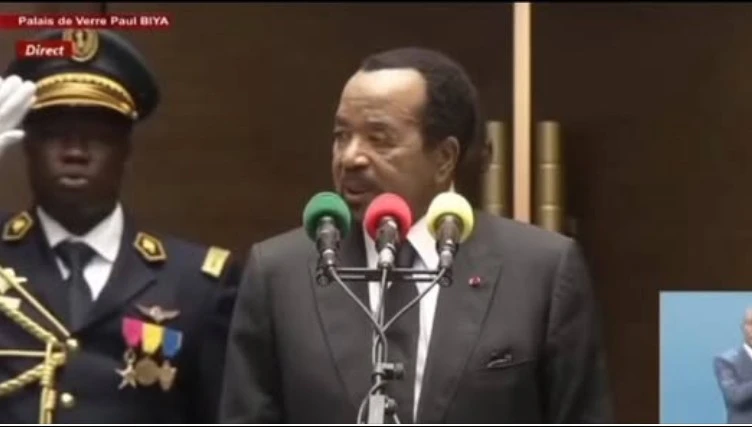
On February 25, 2026, the Supreme Court of Cameroon marked the opening of the judicial year by placing a crucial issue at the center of discussions: the balance between public order and fundamental freedoms. Marie Claire Dieudonnée Nseng-Elang, Attorney General at this high court, took the opportunity during the solemn opening to deliver an in-depth analysis of the concept of public order, exploring its multiple facets through the different branches of law.
In her address, Mrs. Nseng-Elang stressed that public order, although multifaceted, rests on a common foundation: safeguarding the essential values of society. In private law, it manifests itself through mandatory rules to which individuals must submit. In public law, it is reflected in the action of administrative authorities, the legislator, and the judge. In private international law, it makes it possible to set aside the application of foreign laws deemed incompatible with the fundamental values of the Cameroonian State. Finally, in public international law, it designates the higher and mandatory standards that govern international society.
The Cameroonian Constitution guarantees fundamental freedoms, including freedom of expression, association, conscience, and movement, while reaffirming the country's commitment to international human rights instruments. However, the exercise of these freedoms can sometimes conflict with the imperatives of maintaining public order. According to the Attorney General, this relationship is dialectical: public order may justify restrictions on freedoms, provided that they are necessary, proportionate, and justified by a real risk of disturbance.
Mrs. Nseng-Elang insisted that public order should not be seen as a mere constraint, but also as a necessary condition for the realization of freedoms. The two notions, although distinct, are complementary. The law of December 19, 1990, which governs the use of weapons during the maintenance of order, and that of December 23, 2014, relating to the repression of acts of terrorism, illustrate this search for balance between the protection of freedoms and the need to ensure security.
Beyond the classic considerations of public safety, health, and morality, public order today faces new challenges related to the digital age, health crises, environmental demands, and the fight against terrorism. The Attorney General pleaded for an evolving conception of public order, capable of adapting to social changes and new rights. The Supreme Court, through the voice of Marie Claire Dieudonnée Nseng-Elang, recalled that the consolidation of the rule of law in Cameroon requires a constant balance between the protection of social order and the preservation of individual freedoms, a delicate arbitration entrusted to the legislator and, ultimately, to the judge.