


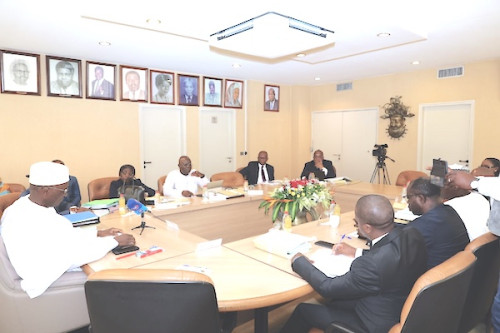
Cameroon's National Investment Corporation (SNI) held its first board meeting as a public capital company on March 12, 2026, in Yaoundé, marking a crucial step in its reform. This session, chaired by Johnny Razack, officially launches the operational phase of a transformation aimed at making the SNI a public financial instrument dedicated to productive investment.
The board meeting follows up on the overhaul initiated by the decree of July 10, 2024, refocusing the SNI's mission on mobilizing and allocating funds to strategic sectors for the Cameroonian economy. These sectors include industry, agriculture, mining, finance, commerce, and services. The directors examined internal organizational aspects, activity planning, and the establishment of the company's governance.
The SNI's reform aims to transform it from a mere manager of public holdings into an institutional investor capable of financing structuring projects within the framework of the National Development Strategy 2020-2030 (SND30). The goal is to break with the past, where the SNI was seen as a wealth manager rather than an active player in economic financing. The transition to public capital company status aims to adopt management standards close to those of commercial companies, in accordance with the 2017 law on public enterprises and OHADA standards.
The change in technical supervision, moving from the Ministry of Industry to the Ministry of Economy (Minepat), illustrates this strategic repositioning. The SNI is now seen as a cross-cutting tool for financing economic transformation, rather than a simple sectoral instrument. The possibility of creating subsidiaries in Cameroon and abroad reinforces this orientation, giving it flexibility similar to that of an investment holding company.
The composition of the new board of directors, with the presence of Célestin Tawamba (Gecam) and Gwendoline Abunaw (Ecobank Cameroon), reflects a desire to integrate skills from the productive and financial private sector. These profiles are familiar with the constraints of financing, production, risk, and profitability, bringing valuable expertise to the SNI's governance.
The credibility of this transformation will depend on the executive management's ability to execute. The SNI must select viable projects, mobilize financing, and arbitrate capital commitments. Its expanded missions now include assessing economic and financial viability, monitoring public companies, conducting diagnostic studies, and intervening in venture capital and stock market intermediation.
With a capital increase of 200 billion FCFA, financed by the State in four annual installments, the SNI must prove its ability to transform these resources into productive investments. Institutional streamlining, with the dissolution of three public entities and the transfer of their assets to the SNI, aims to concentrate functions and avoid overlapping competencies. The major challenge is to translate institutional ambitions into concrete results for the Cameroonian economy.


