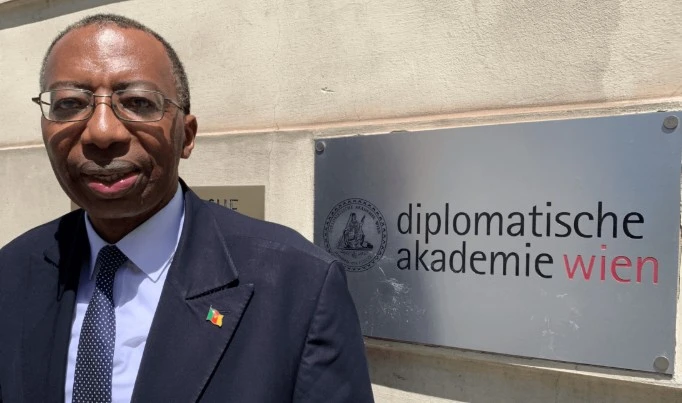
During the solemn commencement of the National School of Administration and Magistracy (ENAM) in Yaoundé on March 5, 2026, Professor Jean-Emmanuel Pondi challenged future Cameroonian senior officials on a crucial topic: African sovereignty. His speech highlighted the challenges Africa faces regarding digital, economic, and military sovereignty, questioning the continent's ability to exercise real control over its own resources and future.
Pr. Pondi emphasized that while Africa won the legal battle for political independence, it risks losing the economic and technological war. He denounced foreign domination over Africa's digital infrastructure, where 99% of undersea cables, cloud platforms, and operating systems are controlled by actors based in California or China. This situation transforms Africa into a "digital colony," providing sensitive data without mastering its value.
Economically, the professor highlighted the seizure of land and natural resources by multinational corporations and foreign sovereign wealth funds. Mining and oil contracts, often negotiated in opacity, deprive African populations of income from their subsoil. When states try to regain control, they face international arbitration tribunals that condemn them to pay billions of dollars.
Military sovereignty is also compromised by the presence of foreign military bases and the plundering of African waters by foreign fishing vessels. Pr. Pondi insisted that Africa must transform its formal sovereignty into operational sovereignty by adopting four key strategies.
First, continental unity is essential to negotiate with one voice against structured blocs such as the European Union, the United States, and China. Second, it is imperative to train high-level technical expertise in Africa, with lawyers, climatologists, data scientists, and economists able to defend the continent's interests. Third, Africa must demonstrate legal audacity and normative innovation, drawing on its own legal heritage to create universal standards. Fourth, Pr. Pondi advocated for legal pluralism, integrating African legal traditions, such as restorative justice inspired by Ubuntu or Ujamaa, into international law.
Pr. Pondi's message comes in a context where the African Continental Free Trade Area (AfCFTA) is trying to reshape the continent's economic exchanges and where African sovereignties are being tested. Africa must live, defend, and embody its sovereignty in every negotiation and strategic decision, thus entering the arena of international law as a full-fledged actor. Africa must no longer be content with invoking its sovereignty, but translate it into concrete actions.