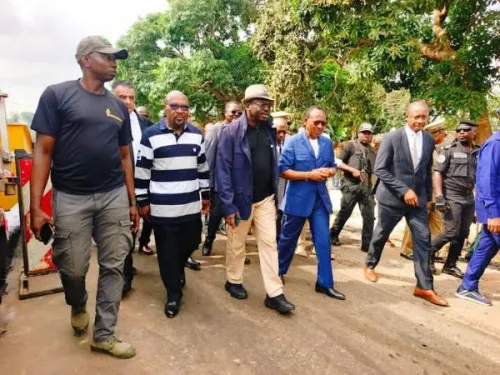
The Lékié road loop development project in the Centre region is facing a new financial challenge. The technical services of the Ministry of Public Works (MINTTP) estimate that an additional 11 billion FCFA is now needed to complete the works. This increase would bring the total budget to 42 billion FCFA, compared to the initially budgeted 31 billion FCFA.
According to MINTTP, these additional costs are due to the inclusion of "new prices" and variations in quantities compared to the basic market. This is the second budget adjustment in less than a year. Six months ago, the ministry had already requested an additional 9.8 billion FCFA. At that time, the cost was estimated at 31 billion FCFA for the company in charge of the works and 1.3 billion FCFA for the control mission.
Initially scheduled for December 2024, then postponed to December 27, 2025, the Lékié loop construction site is significantly behind schedule. Three years after the start, the project shows a budget overrun of 38% and a still partial execution rate. At the end of February 2026, the level of completion was 59% and is expected to reach 63% by the end of March, according to ministry forecasts.
The remaining works mainly concern earthworks, the laying of base and wearing courses, as well as the construction of culverts, gutters and ditches. The provisional acceptance of the site is now scheduled for November 2026.
The Lékié loop, located at the north-western exit of Yaoundé, includes three sections: Nkolbisson – Zamengoué interchange (9.05 km); Zamengoué – Ekékam – Evodoula (43.950 km); Ekékam – Monatélé (28.5 km). This project aims to improve traffic flow and serve the peripheral localities of the capital. However, these delays and cost overruns raise questions about budgetary control and the planning of major infrastructure projects in Cameroon.