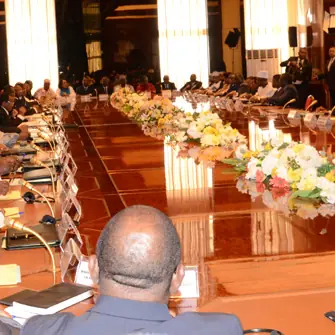
In Cameroon, a disturbing phenomenon has emerged: ministers remaining in office for over a decade without ever addressing the press. This practice raises questions about transparency and the relationship with power. In a context where accountability is a duty in established democracies, silence has become a longevity strategy for some members of the Cameroonian government.
These ghost ministers, whose media presence is limited to official communiqués and ceremonial appearances alongside the Head of State, sometimes lead strategic departments such as education, health, or public works. Their decisions commit billions of CFA francs and affect the daily lives of millions of Cameroonians, yet they remain inaccessible to the media and, therefore, to the people.
Several reasons explain this behavior. Incompetence is often pointed out, with some ministers owing their positions to political or ethnic balances rather than their actual skills. Facing the press would then amount to risking the disclosure of their shortcomings. Fear of sanction is another explanation. In a system where appointment and retention in office depend on the goodwill of one man, every public statement is a risky bet. An awkward declaration, an erroneous statistic, or an unfulfilled promise can lead to immediate revocation. Thus, silence becomes a survival strategy.
This strategic silence is self-sustaining, with new ministers observing their elders and reproducing the model. Communication is then reduced to language elements prepared by advisors, read on rare official occasions. Improvisation and direct exchange with citizens via the media are proscribed. Opacity thus becomes a guarantee of longevity, protecting past mistakes and possible compromises.
The consequences of this institutionalized contempt are multiple. In the short term, citizens are kept in ignorance of public policies, knowing neither what their ministers are doing, nor why they are doing it, nor with what means. Budgets are voted without public debate, projects launched without explanation, and failures never assumed. Journalists, reduced to relaying communiqués, see their role as a counter-power emptied of its substance.
In the long term, this practice undermines confidence in institutions. The citizen feels excluded, despised, reduced to the role of passive taxpayer. Anger simmers, but without media outlet, it takes refuge in social networks and private conversations. The social contract is thus weakened. The question of when a minister will agree to account for his actions to Cameroonians remains pending. As long as silence remains the key to political longevity, ghost ministers will continue to haunt the corridors of power.
The Cameroonian government has implemented measures to improve the transparency and efficiency of public administration, in particular through digitalization and the implementation of software to combat ghost workers. In June 2025, the Minister of Public Service and Administrative Reform, Joseph Le, presented in Douala a software designed to combat the phenomenon of ghost workers in the public service.