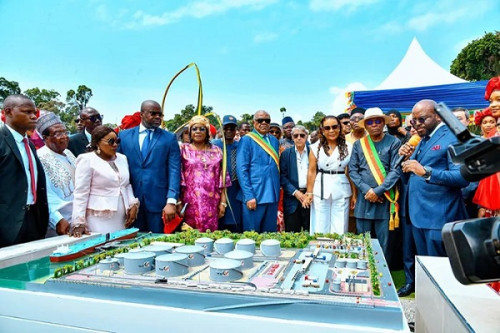
Technical and financial studies for Cstar's refinery and storage depot projects in Kribi have determined the investment needs. The construction cost of the refinery is now estimated at CFA 372 billion, while the oil depot represents an investment of CFA 168 billion. The total combined investment, therefore, amounts to CFA 540 billion.
A source close to the matter indicates that the studies have precisely determined the costs of the various projects and that each shareholder's commitments have been clearly defined.
Located on 250 hectares in the Kribi industrial-port zone, the refinery benefits from structural banking support: BGFIBank will mobilize CFA 120 billion. The balance of the financing will be split between Ariana Energy (49%), Tradex S.A. (31%), and SNH (20%).
The schedule anticipates the finalization of FEED (Front-End Engineering Design) studies in June 2026, before the launch of heavy construction work. Equipment delivery is scheduled for September 2026, with production starting around December 25, 2026. The initial capacity is set at 10,000 barrels per day, before increasing to 30,000 barrels per day from 2027.
According to CSTAR, this anticipated production of 10,000 barrels per day would cover approximately 22% of the national demand for diesel and gasoline as early as 2026. This projection represents a notable acceleration compared to the initial schedule, which placed commissioning in June 2028. A loan agreement, authorized by the Board of Directors on February 19, is expected to accelerate the project.
The oil depot, with an estimated cost of CFA 168 billion, will be fully financed by SNH's own funds. The terminal will have a storage capacity of between 250,000 and 300,000 m³ for products such as diesel, gasoline, jet A1, kerosene, and HFO.
The success of the project now depends on the execution phase, which is crucial to realizing an infrastructure presented as strategic for Cameroon's energy independence.