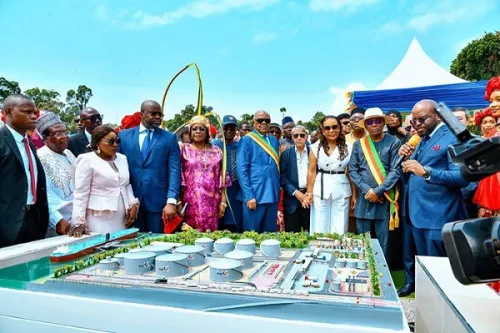
The CSTAR refinery project in Kribi, a cornerstone of Cameroon's energy independence, has had its construction cost reassessed at FCFA 372 billion. This reevaluation follows technical and financial studies conducted on the project's two components: the refinery itself and the associated storage depot. The total investment for the entire complex now stands at FCFA 540 billion, including the FCFA 168 billion allocated to the TankFarm.
According to a source close to the matter, these studies have made it possible to precisely determine the costs and clarify the financial commitments of each shareholder. BGFIBank will mobilize FCFA 120 billion to support the project. The remainder of the financing will be provided by Ariana Energy (49%), Tradex S.A. (31%) and the Société Nationale des Hydrocarbures (SNH) (20%).
The updated schedule anticipates the completion of FEED (Front-End Engineering Design) studies in June 2026, paving the way for major construction work. Equipment delivery is scheduled for September 2026, with production targeted to start around December 25, 2026. Initial capacity will be 10,000 barrels per day, before reaching 30,000 barrels per day from 2027.
CSTAR estimates that this initial production would cover approximately 22% of national demand for diesel and gasoline from 2026. This projection marks a significant acceleration compared to the initial schedule, which foresaw commissioning in June 2028. A loan agreement, authorized by the Board of Directors on February 19, reinforces this approach and should accelerate the project.
The oil depot, fully financed by SNH from its own funds, will have a storage capacity of between 250,000 and 300,000 m³ for various petroleum products. The Kribi complex spans 250 hectares in the industrial-port zone. The project is being executed by a consortium comprising RCG Turnkey Solutions, Global Process Systems (GPS) and Norinco International.
The Kribi refinery is presented as a strategic element for Cameroon's energy independence, reducing dependence on imports of refined products. Since the fire at the SONARA refinery in 2019, Cameroon has been entirely dependent on imports. The project could generate annual savings of around FCFA 400 billion by reducing fuel imports and export revenues of around FCFA 141 billion per year. It is also expected to create approximately 7,000 jobs. The completion of technical studies, the effective launch of works and the securing of additional financing are now priorities to ensure the realization of this infrastructure.