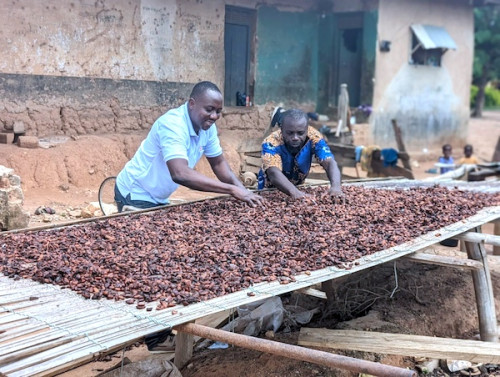
Cocoa prices in Cameroon have experienced a slight increase, but remain well below the government's initial forecasts for the current season. According to data from the Système d’information des filières (SIF) of the Office national du cacao et du café (ONCC), the price of cocoa beans ranged from 1200 to 1300 FCFA per kilogram in the Cameroonian production basins as of March 19, 2026. This price range represents an increase of 150 FCFA compared to the previous month, when prices fluctuated between 1050 and 1150 FCFA.
Despite this progress, current prices are considerably lower than the targets set by the government at the beginning of the season. After reaching peaks of 6000 FCFA/kg in 2023-2024 and 5400 FCFA/kg the following season, the government was aiming for prices between 3200 and 5400 FCFA for the 2025-2026 season. The significant gap between actual prices and projections is largely due to the international economic situation.
Various analysts believe that world cocoa production should experience a surplus during the 2025-2026 season, thus prolonging the recovery started in 2024-2025 after three years of deficit. Ecuador, in particular, is playing a key role in this increase in supply, even threatening to surpass Ghana as the world's second-largest producer. This situation is exerting downward pressure on cocoa prices, both internationally and in Cameroon.
Cocoa production in West Africa, which accounts for approximately two-thirds of global production, has declined in recent years. Côte d'Ivoire and Ghana, which alone produce more than 60% of the world's cocoa, have seen their production decrease due to aging trees and diseases. This decrease in supply, combined with stable global demand, led to a sharp increase in prices in late 2024 and early 2025.
However, forecasts for the 2025-2026 season are mixed, with hopes for a modest recovery thanks to improved rainfall. The International Cocoa Organization (ICCO) even forecasts a slight surplus if weather conditions remain favorable. Despite these prospects, analysts remain cautious about the impact of structural problems and storage conditions on bean quality, which could lead to further price volatility.