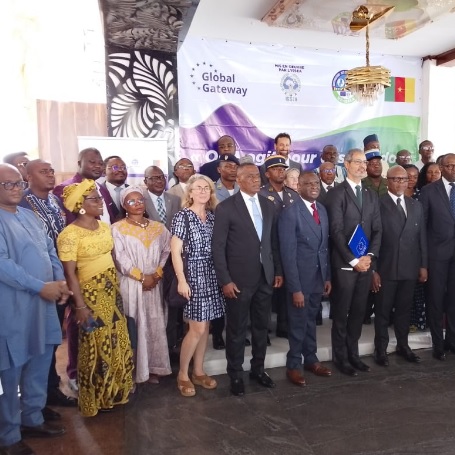
The Sub-regional Institute of Statistics and Applied Economics (ISSEA), under the aegis of CEMAC and with financial support from the European Union, recently concluded a regional workshop in Yaoundé, Cameroon, focusing on combating abnormal practices that hinder the flow of trade in Central Africa. This workshop, which ended on March 11, 2026, marks the culmination of a project initiated in 2021 to identify and assess obstacles to trade in the sub-region.
A major finding emerged from the discussions: efforts to counter abnormal practices on Central African corridors are bearing fruit, resulting in a noticeable decrease in road harassment. The Observatory of Abnormal Practices on Central African corridors (OPA-AC) has played a crucial role in this process by diagnosing problems hindering sub-regional transit, whether port transit, customs, or road traffic.
ISSEA investigators spent years traversing major corridors, including Douala-Ndjamena and Douala-Bangui, as well as examining operations in the ports of Douala and Kribi. The results of these investigations were presented at the workshop, painting an encouraging picture. According to Marcel OPOUMBA, Director General of ISSEA, the impact of the Observatory is real and measurable, with significant changes observed, particularly on the Douala-Ndjamena corridor.
In 2021, investigators identified 104 stopping points on the Yaoundé-Ndjamena corridor, including 70 checkpoints manned by law enforcement and customs officials, mainly on the Cameroonian side. Thanks to the OPA, CEMAC has set up a joint brigade supervised by the Corridor Steering Committee, which has made it possible to pass information back to the countries concerned and carry out spot checks. In 2025, checks revealed a marked improvement, with the number of stopping points reduced to 79, including 46 checkpoints.
This reduction in barriers has had a positive impact on transport costs, thus stimulating economic competitiveness. On the Yaoundé-Bangui route, harassment cost around 2,000 CFA francs every 100 kilometers. The Yaoundé-Libreville route has seen an even more spectacular development, with expenditure falling from 250,000 CFA francs to 125,000-150,000 CFA francs every 100 kilometers.
The European Union, a financial partner in the project, welcomed ISSEA's integrated approach, stressing that freeing up growth means facilitating the movement of people and goods. Philippe LACOSTE, Chargé d'Affaires at the European Union Delegation in Yaoundé, stressed the need for corridors where traffic is free and without harassment, as the latter has a cost that is passed on to the consumer.
The OPA-AC closing workshop marks an important step towards smoother movement of goods and people in the CEMAC zone. ISSEA's evidence-based approach should help decision-makers take steps towards freer and more competitive sub-regional traffic. Despite the sub-region's wealth, intra-community trade remains low, accounting for less than 3.5% of total trade.