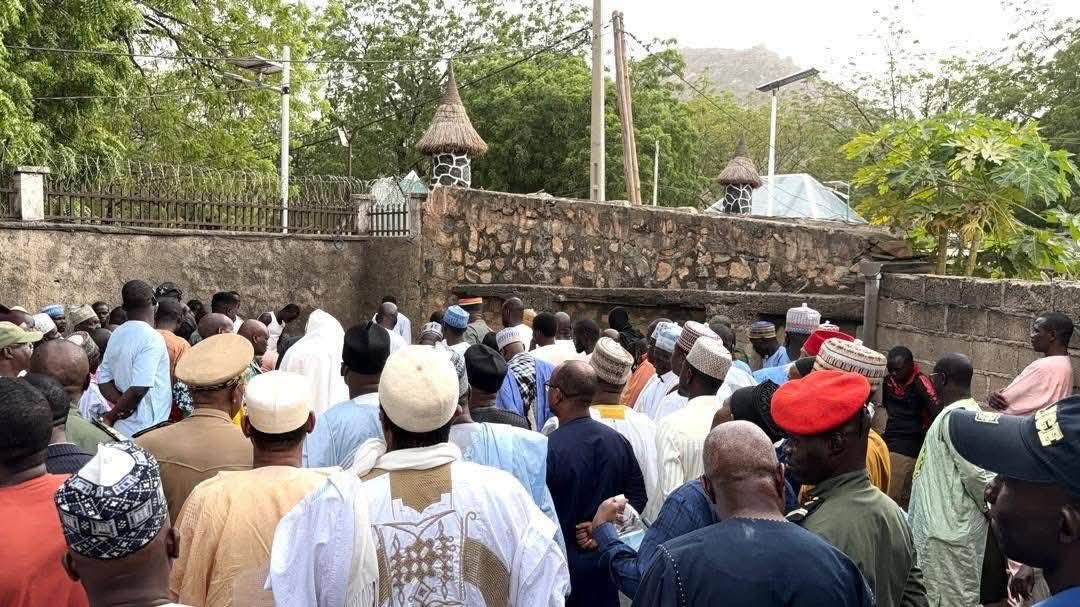
Former President of the National Assembly, Cavayé Yéguié Djibril, was buried in his native village of Mada, in the Tokombéré subdivision, Far North region, a few hours after the announcement of his death at the age of 86. The funeral took place according to Muslim rites. This burial marks the end of a long political career of more than three decades at the head of the National Assembly.
Cavayé Yéguié Djibril, born on February 1, 1940, presided over the National Assembly for 34 years, from 1992 to 2026, becoming an emblematic figure in the Cameroonian political landscape. A member of the Cameroon People's Democratic Movement (CPDM), he was also a member of Parliament for Mayo-Sava since 1983. His political career began in the 1970s, climbing the ranks to become a central figure in Paul Biya's regime.
The burial ceremony took place in sobriety, respecting Islamic traditions, and brought together relatives, authorities and political figures. Official tributes hailed a man of experience and fidelity to the institutions.
While some observers praise his longevity as a guarantee of stability, others criticize his role, seen as an embodiment of a system marked by the permanence of elites and a certain distance from social concerns. His departure from the head of the lower house, a few weeks before his death, had already marked a turning point. Théodore Datouo was elected to succeed him.
Since the announcement of his death, reactions have multiplied, highlighting the importance of his political legacy and his impact on Cameroonian society. Cavayé Yéguié Djibril leaves behind a singular trajectory, the interpretation of which continues to fuel discussions within Cameroonian society.
Datouo's rise to the presidency of the National Assembly marks a turning point, ending more than three decades of Djibril's reign. While his belonging to the same ruling party suggests a continuity of policies, this change offers a glimmer of hope to a population aspiring to a younger representation more in tune with its concerns.
Now buried in his native village, Cavayé Yéguié Djibril leaves behind a complex legacy, oscillating between institutional stability and political immobility.