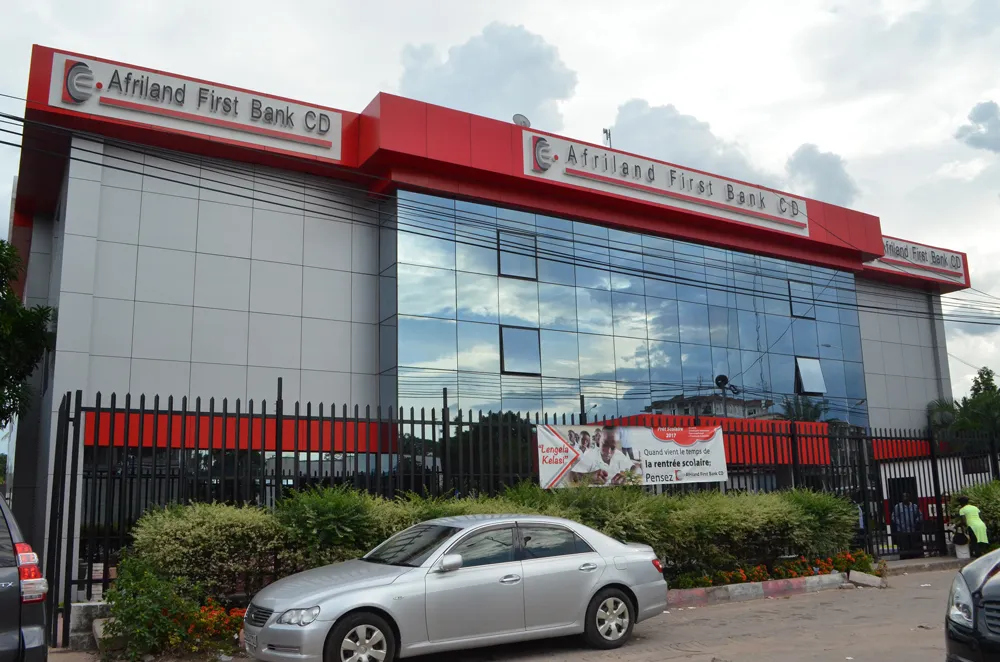
Since being placed under provisional administration in June 2022, and subsequently under a resolution regime, the financial situation of Afriland First Bank DRC has continued to deteriorate. Data from the Central Bank of the Congo (BCC) for December 2025 reveals a marked decline, with a negative net banking income (NBI) of $4.68 million, contrasting with a positive NBI of $2.241 billion for the entire Congolese banking sector.
NBI, a key indicator of bank profitability, reflects the income generated by the bank's core activity. A negative NBI means that financial expenses, including interest on deposits, exceed the income derived from loans and financial services. At the end of 2025, Afriland reported $124.9 million in customer deposits and $175 million in gross loans. However, a significant portion of these loans, particularly those granted to private companies (70% of the portfolio), no longer generate income. Only $37.8 million of loans are considered performing, representing 21.6% of the total. In response to this situation, the bank has set aside provisions for non-performing loans of $131.9 million.
In parallel, Afriland has lost market share in payments to public sector employees, reducing its commission income. In 2025, the bank was stripped of contracts to manage salary payments for teachers and operational funds for schools in five regions, in favor of other financial institutions. This lost portfolio represented 29,513 employees, 2,039 schools, and a monthly payment volume of approximately 12 billion Congolese francs.
Afriland closed the year 2025 with losses of $50.4 million and negative equity of $116.9 million. This situation increases the need for recapitalization, especially since banks operating in the DRC must maintain a minimum capital of $50 million since January 2025. As early as March 2022, the BCC estimated Afriland's recapitalization needs at $90 million.
The provisional administration of Afriland First Bank DRC was established on June 20, 2022, following a governance crisis and disagreements over an audit. Afriland First Group (AFG), the majority shareholder controlled by Cameroonian businessman Paul Kammogne Fokam, had conditioned any recapitalization on a contradictory audit, a request that the BCC reportedly rejected. AFG is contesting its removal and has initiated international arbitration proceedings against the DRC with the International Centre for Settlement of Investment Disputes (ICSID).
Under a resolution regime since January 2023, Afriland is subject to the final stage of banking supervision under Congolese law. This regime allows authorities to quickly restructure failing institutions when their solvency is threatened. However, by the end of 2025, the objectives of restoring profitability and solvency had still not been achieved. Afriland's financial situation has deteriorated since the start of the crisis in 2021. The resolution commissioner has broad powers, including replacing governing bodies and deciding on measures such as opening up capital to new investors or selling assets.
Faced with this situation, the risk of seeing the historical majority shareholder, AFG, lose its stake appears increasingly high. In February 2026, Afriland First Group denied any involvement in the crisis, emphasizing that it had lost operational control of the subsidiary since July 2021. The parent company also distanced itself from the salary payment problems at the Gbadolite hospital, assuring that it has no control over the bank in the DRC. The arbitration proceedings initiated by AFG are ongoing, and their outcome will be made public in due course.