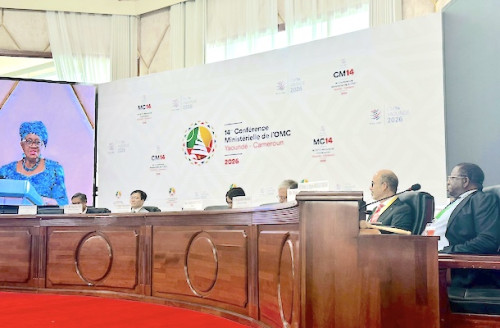
The main African cotton-producing countries, gathered in Yaounde, aim to transform their economic model by attracting massive investments in the local processing of cotton, from fiber to finished product. This initiative was presented on March 25 at a high-level conference on the Cotton Partnership (PPC), on the sidelines of the 14th WTO Ministerial Conference.
The central idea is to reduce the export of raw cotton and significantly increase the added value retained in Africa. The Cotton Partnership, launched in 2024 with the support of the WTO and various partners, aims to create an attractive offer for investors across the cotton value chain by 2030.
The C-4+ countries (Benin, Burkina Faso, Mali, Chad and Ivory Coast) together produce more than one million tons of cotton per year, representing about half of African production and nearly 4% of world production. However, only 2% of this cotton is processed locally. The WTO Director-General, Ngozi Okonjo-Iweala, points out that 98% of the cotton produced in the region is exported in its raw state. The partnership promoters estimate that $12 billion in funding will be needed over ten years to develop spinning, textiles and clothing, creating hundreds of thousands of direct and indirect jobs.
This orientation marks a shift in direction. For more than twenty years, African producers have fought within the WTO against subsidies granted by major powers to their cotton industries, without major success. Now, the goal is to build the missing industries locally rather than wait for a reform of the global market. Jean-Marie Paugam, Deputy Director-General of the WTO, sums up this ambition as "moving up the value chain".
Cameroon, by hosting this initiative, seeks to strengthen its diplomatic position and take advantage of the potential industrial and logistical benefits in Central Africa. Cotton is a key lever for regional industrialization, as recalled by the Minister of Trade, Luc Magloire Mbarga Atangana. Sodecoton achieved a turnover of 223.35 billion FCFA in 2024, with a net profit of 5.49 billion and an added value of 44.39 billion. Exports of raw cotton brought in 177.2 billion FCFA, or 5.4% of the country's total export earnings.
National production could reach 350,100 tons in 2025, after 340,000 tons in 2024. The National Development Strategy 2020-2030 aims to process at least 50% of local fiber by 2030 and integrate at least 60% of Cameroonian cotton into the uniforms of major state bodies. An industrial project to process 12,000 tons per year, amounting to 180 billion FCFA, is in preparation. The objective is to increase the share of the secondary sector in GDP to 36.8% by 2030 and to reach a manufacturing added value of 25%.
This new approach emphasizes the industrial potential of African cotton rather than just the trade war. The challenges related to financing, energy costs, logistics and industrial competitiveness remain to be overcome. It is on this ground that the credibility of this new African strategy for cotton will be played out, transforming a simple raw material into an engine of local development.