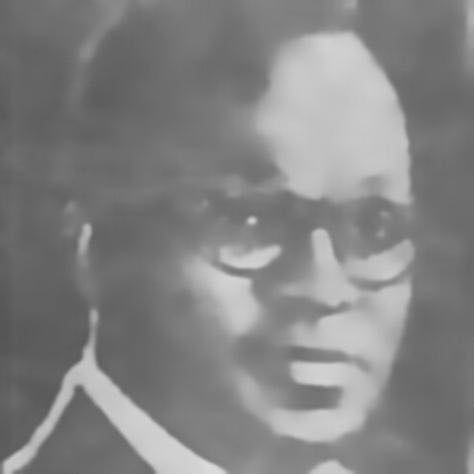
Sixty years ago, on March 15, 1966, Osendé Afana, an economist and activist with the Union of the Peoples of Cameroon (UPC), was assassinated in Ndélélé. As the first doctor of economics in French-speaking Black Africa, Afana was a fervent advocate for the independence and national sovereignty of Cameroon. His assassination marked a tragic moment in the history of Cameroon's struggle for independence, a fight in which he lost his life at the age of 36.
Born in 1930, Osendé Afana studied in Toulouse and then in Paris, where he specialized in economic sciences under the direction of Charles Bettelheim, a Marxist theorist of development. His journey led him to become a virulent critic of economic neo-colonialism, denouncing the illusions of aid offered by capitalist countries. His political commitment was manifested within the UPC, a party that advocated immediate independence and the reunification of Cameroon.
Afana's economic thought is characterized by a sharp critique of neo-colonialism, a reflection on monetary sovereignty, and a pan-African vision of economic development. In particular, he advocated for the creation of an African currency, the "Afrik," anticipating by several decades the debates on the CFA franc. According to Afana, political independence without monetary autonomy is only a facade. He was convinced that many African countries risked becoming "debt slaves" and that aid from Western countries was an instrument of neo-colonialism.
His analysis highlighted the role of complicit local elites, the "comprador bourgeoisies," as transmission belts of neo-colonialism. He insisted on the need for African countries to regroup regionally to promote their development and to control their natural resources in order to escape the neo-colonial commercial logic.
Although less known than other figures of the UPC such as Ruben Um Nyobé and Félix-Roland Moumié, Osendé Afana remains an important figure in Cameroonian history. His work continues to inspire debates on economic independence, monetary sovereignty, and regional integration in Africa. His ideas still resonate today, as African countries face the challenges of indebtedness, economic dependence, and the search for sustainable development.
Osendé Afana's thinking offers relevant perspectives for analyzing the current economic challenges of Cameroon and Africa. His call for genuine economic independence and regional integration remains a crucial issue for the future of the continent. The legacy of Osendé Afana, assassinated 60 years ago, continues to challenge and inspire those who aspire to an economically free and sovereign Cameroon and Africa.